Focus course
The course page you are viewing.
Search highlights matching branches.
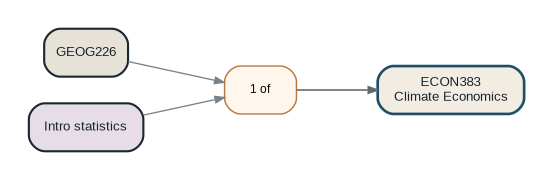
Co-requisites are treated as prerequisite links, and equivalent or cross-listed courses are merged into shared course nodes. The simplified view shows one prerequisite level above the course and one dependency level downstream.
Focus course
The course page you are viewing.
Connected course
A prerequisite or downstream course included in the current view.
Choice point
A shared requirement such as choose 1 of, 2 of, or 3 of.
Grouping junction
A small circular join keeps shared requirement branches tidy.
Merged course node
Equivalent or cross-listed courses are collapsed into one shared node.
Economics of climate change, ranging from the economic drivers of greenhouse gas emissions to the economic impacts and policy solutions. Topics include the physical science basis of climate change, the socio-economic drivers of emissions, as well as estimates of the economic impacts of climate change, and assessments of available policy options to mitigate and adapt to climate change.